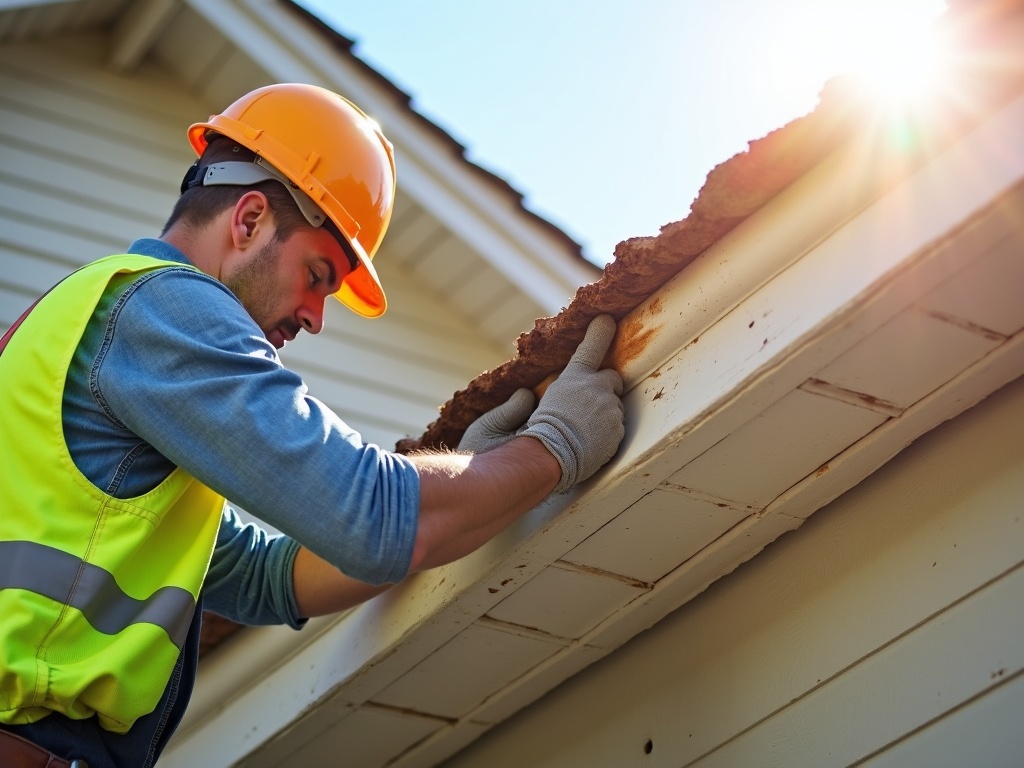
If you have wood fascia in New York, you eventually face this choice: keep repainting it, or wrap it in formed aluminum and stop.
The service life comparison isn’t close. What makes this a real decision is that capping is only the right answer when the wood underneath is sound — and a surprising number of New York homes fail that test without the homeowner knowing.
The service life numbers
Painted wood fascia in New York: 5–7 years per cycle. That’s the realistic interval for a good exterior acrylic on properly prepped wood in this climate. South- and west-facing elevations run shorter — UV plus thermal cycling breaks the film down faster. Elevations under heavy shade or in coastal salt air also run shorter, for different reasons.
The number people quote from the paint can — 10 or 15 years — assumes a wall, not a horizontal-edge board that sits directly under the drip line and takes standing water at every joint. Fascia is the hardest exterior surface to keep coated on a house.
Aluminum capping: 30+ years, no recoating. The finish on quality coil stock is a factory-baked enamel, not a field-applied film, and it’s applied to metal that doesn’t absorb water. You’re not maintaining it. You’re periodically rinsing it.
Over a 20-year window, painted fascia means roughly three cycles of prep, prime, and paint — plus the wood repair that inevitably comes up during prep on the third round. Capping is one job.
Why New York specifically favors capping
The thing that kills paint here is freeze-thaw at the joints.
Every fascia run has butt joints, corner miters, and end cuts. Those exposed end grains absorb water fast. In a New York winter, absorbed water freezes and expands roughly 9%, which opens the wood fiber slightly and breaks the paint bond from underneath. The next thaw lets more water in. By the third or fourth season, the film is lifting at every joint even though the field of the board still looks fine.
You can’t fully solve this with better paint. You solve it by putting a non-absorbent surface between the water and the wood — which is exactly what aluminum fascia capping does.
Upstate and western New York get the most freeze-thaw cycles and see this most severely. On Long Island and in the coastal downstate markets, the driver is different but the conclusion is the same: salt-laden air is aggressive on paint films and on exposed wood, and a factory-finished aluminum surface simply holds up better.
Where capping goes wrong
Here’s the part that matters more than the service life comparison.
Capping over compromised wood hides the problem instead of fixing it. Aluminum coil bends around the board and gets fastened at the edges. If the wood beneath is already soft, wet, or rotting, capping seals moisture in with no drying path — and removes your ability to see what’s happening. The board continues to fail. You find out when a gutter hanger pulls through, three or four years later, and now you’re paying for fascia replacement and re-capping.
This is the most common capping mistake we see on New York homes, and it’s usually well-intentioned: a homeowner is tired of painting, a contractor caps the run, nobody probed the wood first.
The prerequisites for capping are non-negotiable:
- The wood probes solid along the full run — not just where it’s visible.
- The rafter tails behind it are dry and sound.
- Any active water source is fixed first: ice dam infiltration, gutters overflowing behind the board, missing or failed drip edge.
- Gutters are re-hung into solid material, not into the cap.
If any of those fail, the sequence is fascia repair or replacement first, capping second — on the same visit, which is how it’s normally scheduled.
When painting is still the right call
Capping isn’t automatically correct. Painting wins in these situations:
Historic and architecturally detailed homes. Aluminum capping is formed in relatively simple profiles. On a Victorian with a molded fascia and decorative brackets — common across Albany, Saratoga Springs, and Hudson Valley village housing — capping flattens detail that matters to the house and, in a historic district, may not be permitted at all.
Short-horizon ownership. If you’re selling within two or three years, a paint cycle is the cheaper move and presents well.
Fascia that’s already scheduled for replacement. Don’t cap a board you’re replacing next year. Do it once, in the right order.
Mixed material runs where capping only part of the roofline would look wrong. Half-capped elevations read as a repair, not a finish.
Cost, honestly
Capping costs meaningfully more than a paint job on day one — you’re paying for coil stock, brake work to form it on site, and a longer install. A single paint cycle is the cheaper line item every time.
The comparison only makes sense across time. Three paint cycles over 20 years, plus the wood repair that surfaces during prep, plus the fact that you’re back on a ladder or hiring it out every six years — against one capping job that outlasts the window. For homeowners staying put, capping usually comes out ahead somewhere in year 12 to 15, and it comes out ahead sooner on tall or hard-access elevations where every paint cycle carries staging cost.
What to do before you decide
Have the fascia probed, run by run, and get the results per elevation. That single piece of information decides everything else:
- Wood solid throughout — capping is straightforward and it’s the durable answer.
- Isolated soft sections — repair those sections, then cap the run.
- Widespread softness or rafter tail involvement — you’re past capping. That’s a replacement conversation, and our guide to repair versus replacement walks through where the line sits.
The probe test takes minutes and it’s part of the free inspection. It’s worth doing before you buy either paint or aluminum.