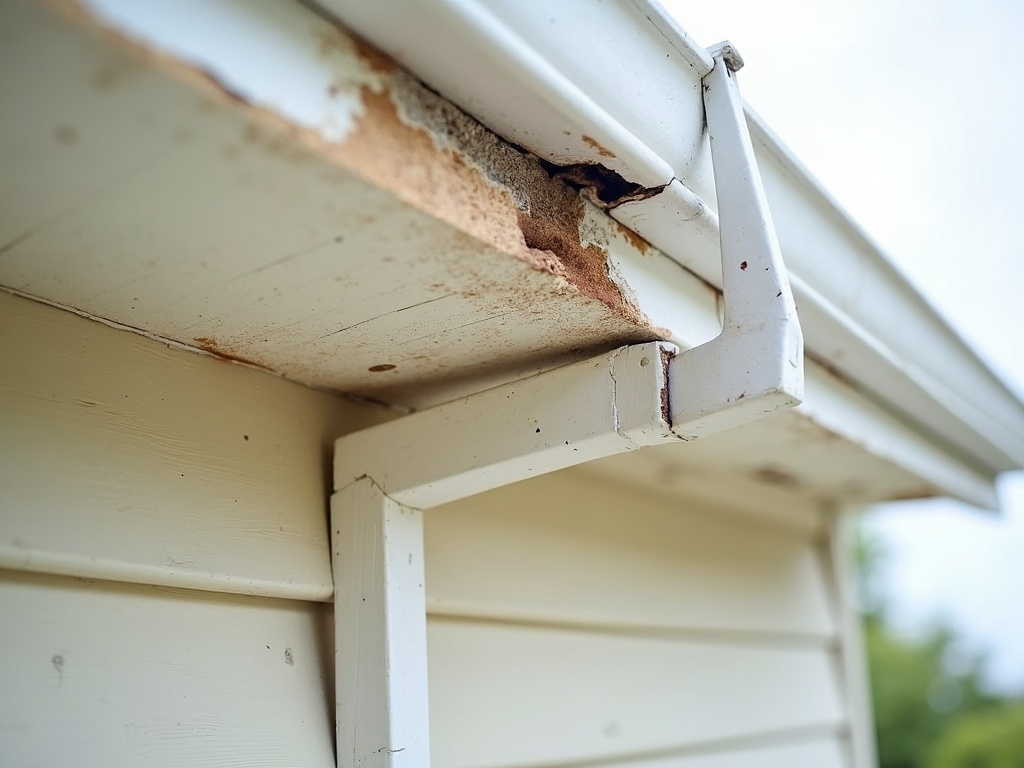
New York’s roofline damage happens in January and becomes visible in April. That lag is the whole reason a spring walkaround is worth doing — you’re not looking for problems that started this week, you’re reading the record of what the last four months did.
This takes about twenty minutes and needs nothing but daylight and a decent pair of eyes. Do it on a bright morning, and do it after the first good rain in spring so you can see how water is actually behaving.
Start from the ground, all four elevations
Walk the perimeter of the house slowly, twice — once looking up at the roofline, once looking down at the ground beneath it. Both directions tell you something.
Looking up, check the fascia line for straightness. The fascia should read as a clean straight line across the whole run. Sag, waviness, or a dip near the middle of a span means the board has lost stiffness — which means it’s holding water.
Check the gutter’s relationship to the fascia. There should be no visible gap between the back of the gutter and the board. A gap means hangers have pulled, and hangers pull for one reason: the wood they’re screwed into stopped holding. This is the single most reliable sign of fascia failure you can see from the ground.
Look for paint failure along the fascia face. Peeling in a horizontal band, especially near joints and corners, is moisture pushing out from behind. Scattered flaking is age. Banded failure is water.
Scan the soffit underside for staining, sag, or gaps. Dark patches, panels that have dropped out of the channel, or daylight visible at panel ends all point to the nailing channel failing.
Looking down, check the ground line. Trenching or eroded mulch in a line beneath the roofline means the gutter overflowed repeatedly. Splash staining on siding at the same height means the same thing. If you find this, whatever caused the overflow was working all winter.
What to check up close if you have safe access
Only where you can reach comfortably from a stable position — a first-floor eave, a low porch roofline. Don’t get on a ladder for this. Nothing on this list is worth a fall.
Probe the fascia. Press a screwdriver into the board at joints, at the ends of runs, and behind the gutter. Sound wood resists. Compromised wood gives, and it gives without splintering — it feels soft, almost like cork. Test at joints first; joints fail before the field of the board does.
Push up on a soffit panel. It should feel fixed. Movement means the channel has softened.
Look at the corner returns. The boxed corner where the fascia turns is where drainage concentrates and where most homes fail first. If you check one spot, check this one.
Inside the house
Two quick checks that catch what the exterior hides:
Ceilings along exterior walls. Stains, especially in a corner or in an upstairs room, mean water got past the eave. Fresh stains are lighter at the edges; old ones have hard rings. Either way, that water came through the roofline.
The attic, if it’s accessible. Look at the underside of the roof deck near the eaves for dark staining or daylight in unexpected places. And check the intake vents where the roof meets the wall — if blown-in insulation has drifted over them, your soffit ventilation is blocked, and blocked intake is the leading cause of ice dam formation. That’s fixable, and fixing it is what stops the damage from recurring. Our soffit ventilation installation page covers what adequate intake looks like.
Regional notes for New York
Snow belt — Buffalo, Rochester, Syracuse, Amherst. Focus on the eaves that carried ice. Fascia damage there is usually backside-in, meaning the painted face looks fine and the board is spent. Probe rather than trusting your eyes, and pay attention to any elevation where you watched ice build up. The ice dam damage guide covers what that failure sequence looks like in detail.
Long Island — Nassau and Suffolk. The driver here is salt air and age, not ice. Most of the housing stock across Bay Shore, Levittown, Massapequa, Smithtown, and Huntington dates to the postwar building boom, which puts original soffit channels, fascia, and gutter hangers all at end of life at roughly the same time. When one component fails on a home of that vintage, check the others — they’re the same age.
Hudson Valley and Capital Region. Heavy tree canopy plus reliable freeze-thaw. Gutter overflow from packed debris is the most common root cause here, and the fascia damage follows from it.
When to stop looking and call
Some findings are worth watching until fall. These aren’t:
- A visible gap between gutter and fascia. The hangers are already failing. The gutter is a heavy object attached to a board that stopped holding it.
- Fascia that gives to a probe anywhere. Soft wood does not dry out and recover.
- A soffit panel out of its channel. That’s an open path for water and for animals — squirrels and birds find eave gaps within one season.
- New ceiling stains near an exterior wall. Active water intrusion.
- Daylight visible through the soffit or at the eave. Whatever made that opening is bigger than it looks from the ground.
Any one of these means the material has crossed from maintenance into repair. What you want to know next is scope — how much of the run, and whether the rafter tails are involved — and that’s what determines whether you’re looking at a section soffit and fascia repair or something larger.
Why spring is the right time
Three practical reasons. The damage is at its most readable — everything winter did is visible and nothing has been masked by summer growth or fresh paint. Contractor schedules are open in April and May, before the summer rush. And repairing now means the next heating season starts with a sound eave rather than compounding a problem that’s already six months old.
The inspection is free, it’s a ladder-level look at what you can only guess at from the ground, and you get a written scope either way. If your walkaround turned up two or more items from the list above, that’s the call worth making.