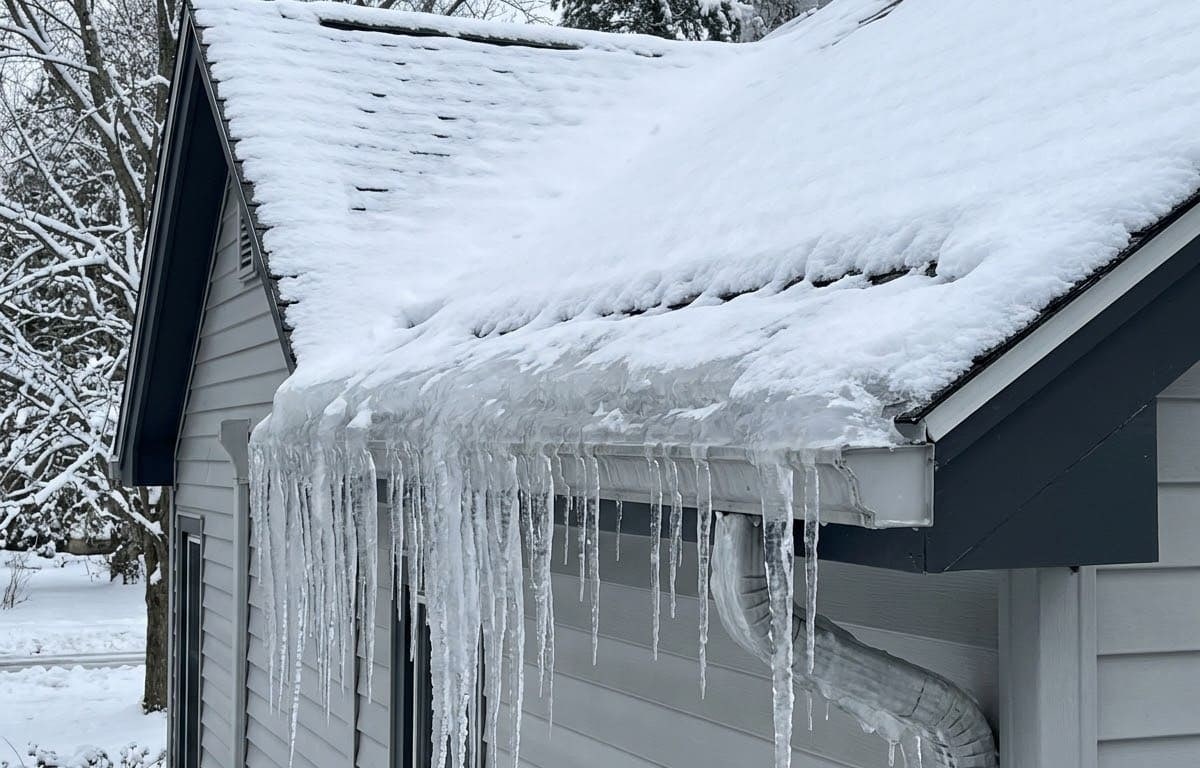
Every winter, homeowners across New York’s snow belt watch ice build up along their eaves and assume it’s a roof problem. It isn’t — or at least, it isn’t only a roof problem. The material that takes the worst of an ice dam is almost always the fascia board and the soffit behind it, and that damage happens weeks before anything shows up on your ceiling.
If you live in Buffalo, Rochester, Syracuse, or anywhere along the Lake Erie and Lake Ontario snow corridors, this is the single most common cause of roofline failure we find on inspection.
How an ice dam actually forms
The mechanism is simple and it has nothing to do with how cold it gets outside.
Heat escapes from the living space into the attic. That heat warms the underside of the roof deck. Snow sitting on the warm section of roof melts from the bottom up, and the meltwater runs down the slope. When it reaches the eave — the last two or three feet of roof that overhangs the wall and gets no attic heat — it hits cold decking and refreezes.
Repeat that over a few days and you get a ridge of ice at the eave. Now every subsequent melt cycle produces water that has nowhere to drain. It pools behind the ice, works backward under the shingle courses, and gets in behind the drip edge.
That’s the point where it stops being a roof issue and becomes a soffit and fascia issue.
Where the water goes next
Behind the drip edge, meltwater has three paths, and it usually takes all three:
Into the fascia board from the back. The fascia’s painted face is the only surface most homeowners ever see, and it’s the only surface that’s genuinely protected. The back face — the side against the rafter tails — is bare wood. Water sits there through the melt cycle, freezes overnight, expands, and opens the wood fiber a little more. Do that thirty or forty times in a season and the board is structurally spent while still looking fine from the driveway.
Down into the soffit nailing channel. The channel that holds your soffit panels is often wood, and it sits directly in the drip path. Once it softens, panels start dropping out of it — which is why you’ll see one sagging panel in April on a house where everything looked fine in November.
Behind the gutter. Ice forming between the gutter’s back edge and the fascia is a mechanical wedge. It doesn’t need much travel to pull hangers loose. When you see gutters visibly separated from the roofline in spring, the ice did that, and the fascia behind those hangers has already been wet for months.
The regional pattern across New York
Ice dam risk scales with two things: total snowfall and how long temperatures hover around freezing. New York gives you both, in different combinations depending on where you are.
Buffalo and Erie County get lake-effect bands off Lake Erie that can deposit two feet in a day. The pattern we see on Buffalo homes is heavy, fast loading followed by partial melts — a lot of freeze-thaw cycling in a short window, concentrated on north- and east-facing eaves.
Amherst and the northern Buffalo suburbs are dominated by postwar and 1960s–80s housing with modest attic insulation depth by current standards. On Amherst homes the problem is less about extreme snowfall totals and more about attic heat loss producing dams even in average winters.
Rochester and Monroe County average around 99 inches annually off Lake Ontario. The Rochester pattern tends toward long, moderate accumulation rather than single dramatic events — which is arguably worse for fascia, because the eave stays loaded and cycling for weeks at a time.
Syracuse and Onondaga County routinely record 120 inches or more and are regularly the snowiest large city in the country. Syracuse rooflines get the longest continuous ice loading of anywhere we work in New York.
The common thread: in all four markets, the damage is cumulative and invisible. Nobody calls in January. They call in April when a panel drops.
What the damage looks like when you find it
Here’s what homeowners typically report, in the order these signs usually appear:
- Paint peeling or blistering along the fascia face, often in a band rather than in patches. That’s moisture pushing out from behind the board.
- Gutters pitched wrong or pulling away — the hanger screws no longer have solid wood to bite into.
- A soffit panel sagging or fully out of its channel, usually near a corner or a valley where drainage concentrates.
- Ceiling stains near an exterior wall, appearing in late winter or spring. By the time this shows, water has been getting past the eave for weeks.
- Dark staining on the underside of the soffit visible from the ground on a bright day.
If you have two or more of these, the fascia is not going to be salvageable by painting it. A probe test with a screwdriver tells the story in about ten seconds.
Why repairing the fascia alone doesn’t end it
This is the part homeowners find frustrating, and it’s worth being straight about: replacing a rotted fascia board does not prevent the next ice dam. It replaces the casualty, not the cause.
The cause is attic heat reaching the roof deck. The durable fix has two halves — better attic insulation to keep heat where it belongs, and adequate intake ventilation at the soffit so the air under the deck stays close to outdoor temperature. If your soffit panels are solid (unvented) or the vents are packed with blown-in insulation from the attic side, air can’t move, and you’ll be rebuilding the same eave in six years.
That’s why our ice dam damage repair inspection covers ventilation and rafter tail condition, not just the visible boards. Where intake is the limiting factor, soffit ventilation work is usually the cheaper half of the job and the half that decides whether the repair holds.
When to schedule the inspection
April through June. The ice is gone, the damage is at its most readable, and contractor schedules haven’t filled with summer work yet. Waiting until fall means you’re booking against everyone else who noticed the same thing, and you’re gambling that the next winter doesn’t reach the rafter tails.
If you watched ice build up on your eaves this past season — even if nothing has visibly failed — that’s the inspection worth having. The cost of looking is nothing. The cost of finding out in year three is a full soffit and fascia replacement instead of a section repair.