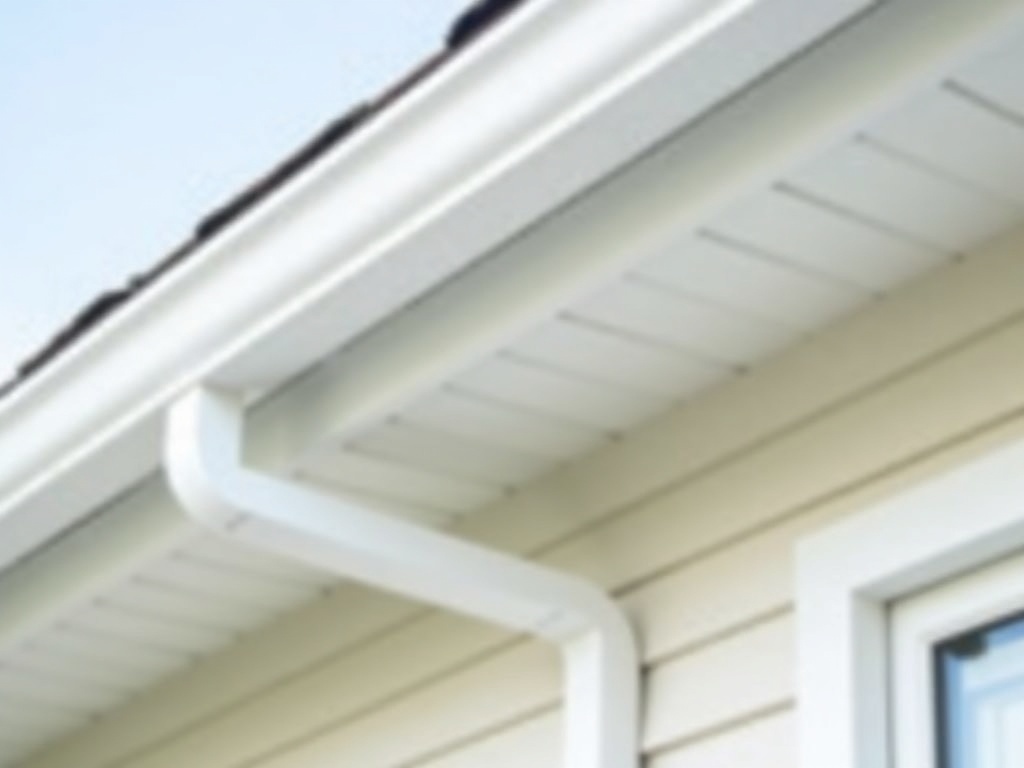
Almost every soffit and fascia estimate a New York homeowner gets comes with two numbers: a lower one to fix the bad sections, and a higher one to redo the whole run. Choosing between them isn’t really a budget decision — it’s a question of whether the undamaged material has enough life left to be worth keeping.
Here’s how to answer that.
The four things that decide it
1. What percentage of the run is compromised
This is the primary threshold, and the number most contractors work from is roughly 30%.
If less than about a third of a continuous fascia run has failed, targeted soffit and fascia repair makes sense. You’re cutting out bad sections, scarfing in new material, and the remaining board has years left.
Above that, the economics flip. The mobilization cost — the ladder work, the staging, the setup — is the same whether you replace four feet or forty. Once you’re replacing a third of a run, you’re paying most of the replacement cost anyway and keeping two-thirds of a system that’s the same age as the part that just failed. That’s when full replacement becomes the better value, and it’s not close.
2. Whether the damage is one cause or one age
There’s a real difference between damage that has a cause and damage that has an age.
A woodpecker hole, a section a ladder went through, a corner return that took a limb in a storm — those are events. The material around them is fine. Repair.
Fascia that’s soft at three separate joints on the same elevation isn’t three problems. It’s one problem: the board is at end of life and the joints failed first because joints always fail first. Replacing those three spots buys you a year before the fourth one goes.
The test question: is there a reason this specific spot failed and the rest didn’t? If you can’t name one, you’re looking at age, not an event.
3. Whether the rafter tails are involved
The fascia is nailed to the rafter tails — the ends of the roof framing that project past the wall. Fascia is a cladding component. Rafter tails are structural.
If a probe finds soft rafter tails behind the fascia, the conversation changes entirely. That’s framing repair, and it has to happen regardless of which path you pick — but it also means water has been getting in long enough and deep enough that the remaining fascia on that run is almost certainly further along than it looks.
This is the finding that most often turns a planned repair into a replacement mid-job, so it’s worth having probed before you commit to a number.
4. What material you currently have
Material type changes the calculus:
- Wood fascia, painted — repairable in sections, but every repair resets a maintenance clock that runs on repainting every 5–7 years in New York’s freeze-thaw climate.
- Wood fascia, aluminum capped — if the cap is intact and only isolated sections are wet, repair is usually straightforward. If water got behind the cap, the wood underneath can be far worse than the exterior suggests.
- Aluminum or vinyl soffit panels — panels themselves rarely fail. The nailing channel holding them fails. If the channel is gone, you’re replacing panels along that whole run whether you wanted to or not.
- Original 1950s–70s material of any kind — on Long Island’s postwar stock, from Levittown through the Nassau and Suffolk tracts that followed it, and on upstate’s mid-century suburbs alike, this material is now past its design life. Repair here is a stopgap by definition.
Where cost actually lands
Repair pricing is driven by access and section count more than by linear footage — two bad spots on a two-story elevation can cost more than fifteen feet on a ranch. Replacement pricing is driven by linear footage, material choice, and how much of the roofline needs staging.
The pattern that catches homeowners out is sequential repairs. Three separate repair visits over four years, each one reasonable on its own, routinely add up to more than a single replacement would have cost at the start — plus you still have aging material. If you’re on your second repair call for the same elevation, run the replacement number before authorizing the third.
Our soffit and fascia cost guide breaks down current New York ranges for both paths, including per-linear-foot pricing by material and the access factors that move the number.
What to ask the inspector
A useful inspection should give you specific answers to these, not general reassurance:
- What percentage of each run is compromised? Not “some of it” — an estimate per elevation.
- Did you probe, or did you look? Fascia that fails a probe test frequently looks perfect from twenty feet. Visual-only assessment is how ice dam and salt-air damage gets missed.
- What’s the rafter tail condition? If the answer is “we didn’t check,” the estimate isn’t final and you should be told that.
- What caused this? If the cause is attic ventilation, ice damming, or gutter overflow, the repair alone won’t hold — and you want that on the estimate, not discovered later.
- What’s the replacement number? Even when repair is clearly correct, knowing the alternative tells you whether you’re spending 20% of replacement cost or 70%.
The straightforward version
Repair when: damage is confined to under roughly a third of a run, you can name the specific cause, the rafter tails probe solid, and the surrounding material has real life left.
Replace when: multiple sections have failed on the same run, the material is at or past its design life, the rafter tails are involved, or you’ve already repaired that elevation once.
And in both cases: fix the cause. Ice dam infiltration, blocked soffit intake ventilation, or gutters overflowing behind the fascia will produce the same failure again on new material, just on a slightly slower clock.
If you’re not sure which side of the line you’re on, that’s exactly what the free inspection is for — and getting the percentage and probe results in writing costs you nothing.